Science-based insomnia support, personalized for your nights
Sleep better without fighting your mind at 3am.
My Sleep Expert gives you a personalized sleep plan, based on CBT-I, strengthened with ACT-informed coaching, and delivered async so you can move at your pace. No generic sleep tips. No one-size-fits-all meditation. Just a clear method, adapted to your insomnia pattern, to rebuild trust with sleep.
- CBT-I based
- ACT-informed coaching
- Expert guided
- Personalized guided sessions
- Downloadable emergency audios
- Async support
- Built for insomnia, not just "wellness"
The problem
Insomnia is not a lack of effort. It is a pattern your nervous system learned.
If you have insomnia, you already know the basics.
You have tried going to bed earlier. You have tried herbal tea. You have tried breathing exercises, podcasts, supplements, apps, white noise, stricter routines, and maybe even medication.
Some things helped for a night. Nothing changed the pattern.
Because chronic insomnia is rarely solved by one more tip. The deeper issue is usually a loop:
- You are tired, so you spend more time in bed.
- You cannot sleep, so the bed starts to feel stressful.
- You wake up and check the clock.
- You calculate how bad tomorrow will be.
- Your brain learns that nighttime is a performance test.
- The harder you try to sleep, the more awake you become.
That loop can be changed. But it needs a method.
And it matters. Insomnia does not only steal nights. It can shrink the next day.
When sleep is unstable for long enough, people often start making life smaller without realizing it. They avoid ambitious projects because their brain feels foggy. They say no to social plans because they are afraid of being exhausted. They become more reactive with the people they love. They work longer hours to do what used to take less time.
Research backs up what exhausted people already feel. Insomnia is associated with poorer cognitive performance, including working memory, attention, alertness, episodic memory, and problem solving. In the America Insomnia Survey, insomnia was associated with the equivalent of 11.3 lost workdays per year from reduced performance while at work, before adjusting for other conditions.
This does not mean one bad week of sleep has ruined your health. It means chronic insomnia deserves serious support. Not panic. Not shame. Support.
Personalization
Your insomnia is not exactly like anyone else's. Your plan should not be either.
Some people cannot fall asleep because their body is not sleepy yet.
Some wake up at 3am with a mind that starts calculating, worrying, and scanning for danger.
Some sleep well for three nights, then one bad night makes them panic and restart the whole cycle.
Some need firmer CBT-I structure. Some need more ACT tools to stop wrestling with their thoughts. Some need a short body-based exercise. Some need less relaxation and more sleep pressure. Some need Yoga Nidra or NSDR-style deep rest. Some need help staying motivated because the first week of real sleep change can feel uncomfortable.
This is why generic sleep content often disappoints. The exercise that helps one person can frustrate another. The advice that is perfect for one sleep pattern can make a different pattern worse.
At My Sleep Expert, every guided session starts from your answers, your sleep diary, your obstacles, and your current week. The plan adapts because you are not a template. The emergency audio adapts too: the person waking with panic at 4am should not receive the same audio as the person who is simply not sleepy at midnight.
Method
The science is CBT-I. The difference is personalization, coaching, and follow-through.
CBT-I, Cognitive Behavioral Therapy for Insomnia, is one of the most researched approaches for chronic insomnia. It does not try to knock you out. It helps you retrain the behaviors, thoughts, timing, and associations that keep insomnia alive.
Research reviews consistently show that CBT-I improves insomnia severity, sleep efficiency, time awake during the night, and remission rates. In one meta-analysis of insomnia with medical or psychiatric comorbidities, 36.0% of people receiving CBT-I were in remission after treatment, compared with 16.9% in control conditions. An evidence review reported that CBT-I reduced insomnia severity by more than 7 points, around 40%, compared with about 10% in passive controls.
That is the foundation. But research is not the same as your Tuesday night.
So we adapt CBT-I principles into a guided async program with personalized sessions, ACT-informed coaching, and practical audio exercises for the exact moments when insomnia usually wins.
You get the structure of a serious sleep intervention, with the warmth of a human team and the convenience of doing it on your own time.
What we work on
- Sleep efficiency. Spending less time awake in bed.
- Stimulus control. Helping your bed become a cue for sleep again.
- Sleep pressure. Rebuilding natural tiredness at the right time.
- BBTI. Brief Behavioral Treatment for Insomnia, when a shorter protocol fits better.
- Cognitive work. Reducing the fear, pressure, and mental noise around sleep.
- ACT tools. Defusion, acceptance, values, and committed action when your mind starts fighting the night.
- Paradoxical intention. Reducing performance pressure by changing the relationship with trying to sleep.
- Night protocols. Knowing exactly what to do when you wake up too early.
- Wind-down audios. Guided exercises that help your body stop rehearsing tomorrow.
- NSDR-style practices. Deep rest protocols for nights when sleep does not come immediately.
- Nervous system work. Breathwork, somatic exercises, pandiculation, body-based practices.
- Morning rhythm. Light, wake time, and routine to stabilize sleep.
- Chronotherapy. Used carefully when sleep timing itself is part of the problem.
Toolkit
We know the sleep toolbox. Then we choose what fits you.
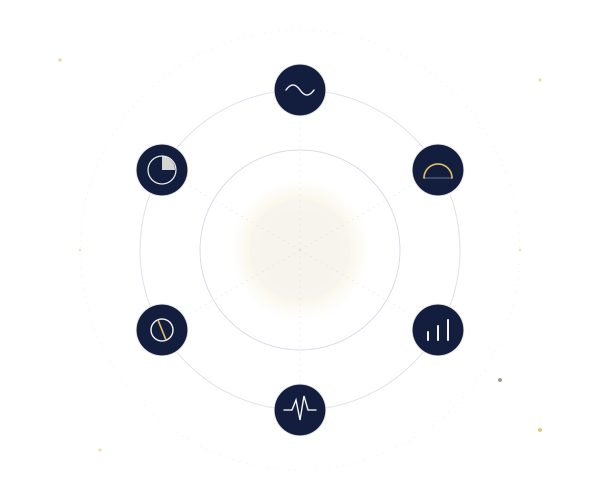
Most programs pick one method and make every client pass through the same door. We do the opposite.
CBT-I gives the foundation, but your plan can also draw from BBTI, ACT, paradoxical intention, breathwork, nervous system regulation, cognitive shuffling, imagery rehearsal therapy, somatic shaking, pandiculation, passive body heating, deep pressure stimulation, Yoga Nidra, NSDR-style rest, personalized sound environments, and carefully selected complementary practices.
For some people, the right next step is behavioral: less time awake in bed, a clearer wake time, stimulus control, or a sleep diary.
For others, the right next step is psychological: stop fighting thoughts, reduce the fear of wakefulness, or learn how to handle the pressure of "I must sleep now."
For others, the body is the door: somatic exercises, breathwork, passive body heating, relaxation, deep pressure, or a guided practice that helps the nervous system downshift.
For others, the environment matters: pink noise, brown noise, light timing, bedroom temperature, or a more stable wind-down ritual.
And sometimes we discuss tools outside the core program, such as red light therapy, vagus nerve stimulation, cranial electrotherapy stimulation, or supplements. Those are handled carefully, because devices and supplements are not right for everyone and may require medical guidance.
The point is not to impress you with a long list. We find the smallest next step that is likely to help your specific sleep pattern.
How it works
A sleep program that does not ask you to be online at the worst time of your life.
- Step 1
Tell us what your nights actually look like.
You begin with a short sleep assessment. We ask about your sleep schedule, waking patterns, time in bed, anxiety around sleep, current habits, and what you have already tried.
- Step 2
We build your first sleep plan.
We review your answers and create a plan for your pattern: difficulty falling asleep, waking during the night, waking too early, or a mix. You will know what to change first and what to stop doing because it is quietly making insomnia stronger.
- Step 3
You receive personalized async sessions.
Instead of waiting for a weekly live call, you receive guided sessions, coaching messages, sleep exercises, and audio practices you can use before bed, during the night, or in the morning. You check in between sessions so the plan adapts to your progress.
- Step 4
We adjust the plan until your sleep becomes stable.
Sleep changes through data and consistency. We track what is improving, what is stuck, and what needs to be adjusted. You are not left alone with a PDF and good intentions.
- Step 5
We keep you going when motivation drops.
Most people do not fail sleep programs because they lack information. They stop because a bad night scares them, a rule feels hard, or life gets messy. We answer questions, send reminders, adjust the next step, and help you keep going.
Why async
Sleep work is often better when it happens between appointments.
Insomnia does not happen in a therapist's office. It happens in your bedroom, in your thoughts, in your habits, and in the decisions you make at 2:47am.
That is why async support works so well for sleep.
You do not need to remember everything for a live call. You check in when the information is fresh. You receive guidance when you need the next step. You can replay the audios at the exact moment your nervous system needs repetition.
Because the program is structured, your expert can focus on the part that matters most: choosing the right next move for your sleep pattern. This is coaching, not content dumping.
If you are stuck, you can ask. If you are confused, we clarify. If you have a bad night, we help you interpret it without panic. If you avoid the plan because it feels uncomfortable, we help you return to it gently.
You are not expected to become your own sleep therapist after reading a few lessons.
What you receive
A complete, personalized sleep program.
Personalized sleep assessment
A clear first picture of your insomnia pattern, including what may be maintaining it.
CBT-I based sleep plan
A practical plan built around sleep efficiency, stimulus control, cognitive tools, and rhythm stabilization.
ACT-informed coaching
Support for the psychological side of insomnia: fear of the night, mental struggle, frustration, avoidance, and the pressure to sleep perfectly.
Async expert sessions
Personalized guidance you can receive and answer on your schedule, without forcing another live appointment into an already tired life.
Personalized guided sessions
Every session is shaped around your sleep data, your answers, your current obstacle, and your preferred style of support.
Night audio toolkit
Guided meditations, cognitive shuffling, breathwork, body relaxation, NSDR-style practices, ACT exercises, paradoxical intention prompts, imagery rehearsal, sound environments, and protocols for early morning awakenings.
Body and nervous system practices
Somatic shaking, gentle somatic exercises, pandiculation, passive body heating, deep pressure stimulation, acupressure points such as Anmian, when they fit your situation.
Tools and device guidance
When relevant, we discuss higher-tech options such as red light therapy, cranial electrotherapy stimulation, vagus nerve stimulation, sleep tracking, or supplements. Cautious language: not universal recommendations, some should be discussed with a clinician.
Downloadable audios
When useful, we adapt exercises to your situation, your language, and your current obstacle. Keep them and replay them whenever you need.
Progress check-ins
Your plan evolves with your nights. We adjust based on what is actually happening, not on theory.
Why this is different
CBT-I works. The problem is that most people receive it in a way that does not fit real life.
Most sleep advice is not wrong. It is just not enough.
Dark room. Less caffeine. Morning light. No phone in bed. Helpful, yes. But if you have chronic insomnia, you probably need more than rules you already know and feel guilty about not following perfectly.
Even CBT-I can fail people when it is delivered too rigidly. You might have tried it before and thought:
- "Sleep restriction made me anxious."
- "The rules were clear, but I could not stick to them."
- "The therapist did not understand my exact pattern."
- "The app gave me lessons, but nobody helped when I got stuck."
- "Relaxation exercises made me monitor my body even more."
- "One bad night made me feel like I had failed the whole program."
My Sleep Expert is different because:
- You are guided by humans, not only software.
- The method is based on CBT-I principles and current behavioral sleep science, not random wellness advice.
- ACT tools help you stop turning sleep into a fight with your thoughts.
- Your plan is adapted to your real nights.
- Each guided session is personalized, not pulled from the same library for everyone.
- The program focuses on behavior change and psychological flexibility, not just relaxation.
- You get audios for the difficult moments, not only education for the daytime.
- You can ask questions when something does not work.
- We coach you through resistance, setbacks, and bad nights.
- Async sessions make the support easier to complete.
Sleep does not improve because someone tells you to calm down. It improves when the system around sleep becomes safe, consistent, and believable again.
Evidence base
Evidence-based does not mean impersonal.
CBT-I is widely recommended as a first-line treatment for chronic insomnia. Large reviews show meaningful improvements in insomnia severity and sleep efficiency, and higher remission rates than control conditions.
But the strongest program is not only the one with the best protocol. It is the one you can actually follow.
That is where personalization and coaching matter. We use the research as the map. Then we adapt the route to your nervous system, your life, your schedule, your motivation, and your pattern of insomnia.
You are not broken
You are not broken. You are tired.
Insomnia can make a capable person feel strangely powerless. During the day, you can run a business, care for a family, solve difficult problems, and keep your life moving. Then night comes, and suddenly your own mind feels like it has turned against you.
This is not a character flaw. It is a learned pattern, and learned patterns can be unlearned.
The goal is not to become someone who sleeps perfectly every night. Nobody does. The goal is to become someone who trusts sleep again, recovers from a bad night faster, and no longer organizes life around fear of bedtime.
Team
A small team for a very human problem.
My Sleep Expert is built by a small team combining lived experience, psychology, meditation, sleep science, and holistic practice.
Samuel Michelot
Founder
Samuel is the founder of My Inner Center, a center of holistic therapies. He started meditation and personal development in 2010, the same period when he began seriously trying to fix his own sleep. After years of insomnia since childhood, doctors, therapies, CBT-I principles, ACT, meditation, Yoga Nidra, Inner Dance, and many experiments, he is now free from insomnia and has not had insomnia for many years. That is exactly why he knows the answer is not one magic technique. The same exercise can save one person's night and do almost nothing for another. Samuel is also an Inner Dance facilitator. His role is to make sleep support feel personal, human, practical, and easier to complete.
Pilar Hostaled
Psychologist
Pilar brings more than 18 years of experience in mental health, with training in systemic family therapy, mindfulness, ACT, EMDR, EFT, Wingwave Coaching, and NLP. She helps keep the emotional side of sleep work grounded, careful, and human.
Free Sleep Expert Review
Get your free Personalized Sleep Expert Review.
Most sleep specialist consultations cost real money. In the U.S., a first sleep specialist consultation can often cost around $150 to $300 before insurance.
For now, we are giving the first step away for free because we are building the launch list for My Sleep Expert.
You answer a short sleep assessment. We use your answers to create a personalized Sleep Expert Review you can download and keep, including two personalized audios for the moments your insomnia usually appears.
Every review is different. Not "personalized" because your first name appears at the top. Personalized because the advice, the exercise, the fall-asleep audio, and the middle-of-the-night emergency audio are shaped around your pattern.
You will receive
- A personalized sleep pattern summary.
- Your most likely insomnia loop.
- One personalized guided audio to fall asleep.
- One personalized emergency audio for waking in the middle of the night.
- A short ACT-informed exercise to stop fighting your thoughts.
- A first CBT-I based recommendation for your pattern.
- Early access to the full My Sleep Expert program when it opens.
Blog
Clear answers for tired people.
Topics include CBT-I, sleep anxiety, waking up at 3am, sleep restriction, stimulus control, guided sleep exercises, meditation for insomnia, and what to do after a bad night.
Tonight does not need to become another test you fail.
You do not have to force sleep. You can learn how to make sleep possible again. Start with the free assessment. We will help you understand your pattern, then guide you toward the next right step.
Get my free Sleep Expert Review