Insomnia Patterns
Why Do I Feel Sleepy on the Sofa but Awake in Bed?
Written by Samuel Michelot. Reviewed by Pilar Hostaled, registered psychologist. · Last updated May 2026
Quick answer
Feeling sleepy on the sofa but wide awake in bed usually means your brain has learned two associations: the sofa means rest, and the bed means effort and pressure. That learned pressure, not a broken sleep system, is what wakes you up. Rebuilding the bed-sleep link with stimulus control is what changes it.
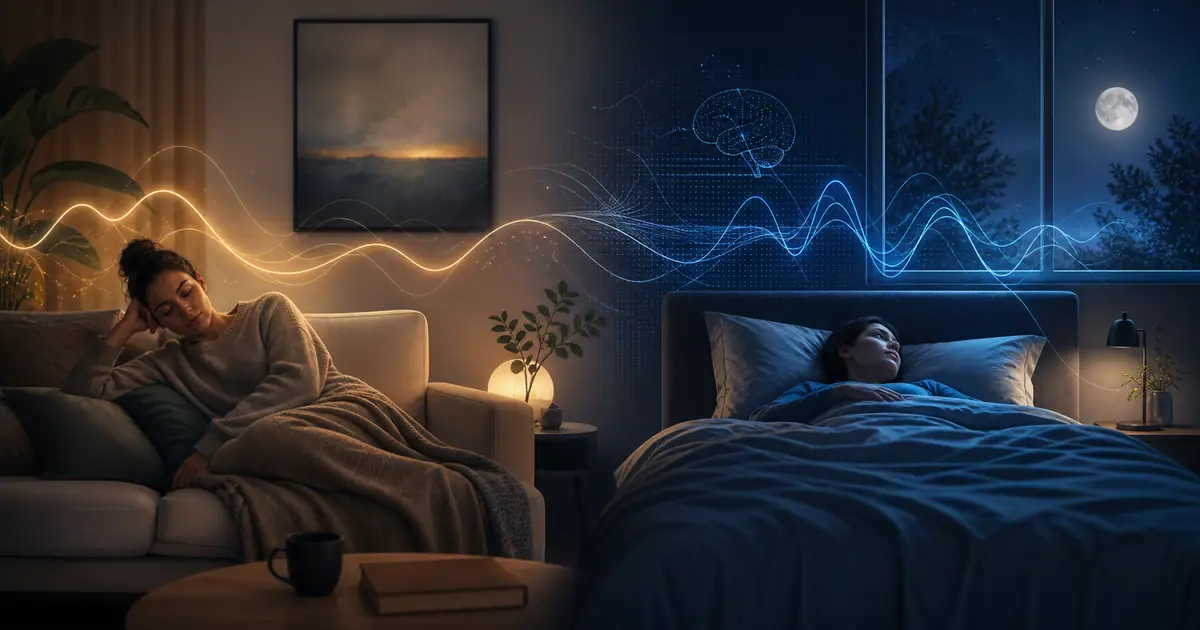
If you feel sleepy on the sofa but awake as soon as you get into bed, your body is not broken. Very often, your brain has learned two different associations: the sofa means rest, and the bed means pressure.
That pressure can be enough to wake you up.
The strange moment sleep disappears
You are on the sofa. Your eyelids feel heavy. The movie is still playing, but you are barely following it. You think, “Great, tonight I will sleep.”
Then you brush your teeth, go to bed, turn off the light, and suddenly your mind is awake.
Now you are thinking:
- Why did my sleepiness disappear?
- Did I miss my sleep window?
- What if this happens again tomorrow?
- Should I get up?
- Should I try harder to relax?
This is one of the most frustrating insomnia patterns because it feels irrational. You were sleepy. Then the place where sleep is supposed to happen made you alert.
But there is a clear insomnia mechanism behind it.
Your bed may have become a cue for effort
In healthy sleep, the bed is a cue.
Your body learns: bed, darkness, pillow, sleep.
With insomnia, the learning can reverse.
After enough difficult nights, your body may learn:
Bed means waiting.
Bed means checking.
Bed means trying.
Bed means tomorrow is at risk.
Bed means “I hope tonight is not another bad night.”
This is called conditioning. It is not a personal weakness. It is how nervous systems learn.
If you spend many hours awake in bed thinking, worrying, scrolling, forcing relaxation, or measuring whether sleep is coming, the bed can start to trigger alertness.
That is why sleepiness can vanish the moment you get under the covers.
Why the sofa feels easier
The sofa usually has less pressure attached to it.
You are not trying to sleep there. You are watching something, reading, or simply resting. There is no performance test.
On the sofa, sleep can arrive quietly because you are not chasing it.
In bed, you may be asking sleep to prove itself.
That small shift matters.
Sleep often comes when conditions are right. It rarely comes because we demand it.
Did you miss your sleep window?
Maybe, but not always.
People often blame the “sleep window”: the idea that if you do not go to bed at the perfect moment, you miss your chance.
There is some truth that sleepiness can rise and fall. But for people with insomnia, the bigger issue is often not a missed window. It is the pressure that appears when you move from “resting” to “trying to sleep.”
If this pattern happens often, focus less on finding the perfect minute to go to bed and more on rebuilding the bed-sleep association.
What to do tonight
The goal is to make bed feel less like a test.
1. Do not rush from sofa sleepiness to bed panic
If you notice sleepiness on the sofa, move gently.
Keep lights low. Avoid checking messages. Do not start calculating whether this is your chance.
Think: “I am carrying sleepiness to bed.”
Not: “I must not lose it.”
2. Make the transition boring
Your bedtime transition should be simple and repeatable.
For example:
- turn off screens
- brush teeth
- dim lights
- short bathroom visit
- bed
Do not add a complicated routine that makes bedtime feel like a project.
3. If bed wakes you up, reduce the struggle
If you get into bed and feel suddenly alert, do not start fighting immediately.
Try a quiet phrase:
My body was sleepy a few minutes ago. I do not need to force anything. I can let the pressure drop again.
Then use one simple practice, such as cognitive shuffling, a neutral body scan, or a personalized fall-asleep audio.
4. If you stay alert, leave the bed briefly
If you are calm but awake, resting may be fine.
If you are frustrated, tense, or mentally activated, consider leaving the bed for a short time. Keep lights low. Do something quiet and boring. Return when sleepiness comes back.
This is not punishment. It is stimulus control: teaching your brain that bed is not where you struggle.
What can backfire
Some common reactions can make the sofa-bed pattern stronger.
Going to bed much earlier
If you are afraid of missing sleep, you may go to bed earlier and earlier.
But if your body is not ready, you spend more time awake in bed. That can make the bed feel even more associated with wakefulness.
Turning bedtime into a ritual you must perform perfectly
Wind-down routines can help.
But if the routine becomes another test, it can backfire.
You do not need a perfect routine. You need a repeatable one.
Using relaxation as a sleep command
Relaxation is useful when it lowers pressure.
It backfires when you use it to demand sleep.
If you are doing a body scan while checking every 20 seconds whether it is working, the body scan has become monitoring.
The deeper solution
This pattern is exactly why generic sleep tips often fail.
The advice “just relax before bed” does not solve a conditioned bed-wake association.
You may need a plan that combines:
- stimulus control
- sleep pressure
- a consistent wake time
- fewer hours awake in bed
- a simpler wind-down transition
- ACT tools for the pressure to sleep
- a personalized fall-asleep audio that does not increase monitoring
The goal is not to make the sofa your new bed.
The goal is to make your bed feel safe, boring, and sleepy again.
Get your free Personalized Sleep Expert Review
If you feel sleepy everywhere except your bed, your sleep pattern needs to be understood before you add another technique.
The free Personalized Sleep Expert Review helps identify your insomnia loop and gives you two personalized audios based on your answers.
Start your free Personalized Sleep Expert Review
Sources
- American Academy of Sleep Medicine, behavioral and psychological treatments for chronic insomnia: https://pmc.ncbi.nlm.nih.gov/articles/PMC7853203/
- American Academy of Sleep Medicine systematic review for behavioral and psychological treatments: https://pmc.ncbi.nlm.nih.gov/articles/PMC7853211/
Get your free Sleep Expert Review
Personalized assessment, two downloadable audios, and a first CBT-I based recommendation for your pattern.
Start my free assessment